Complete Guide to Sneaker Authentication (2026): The Pro Legit Check System
Sneaker authentication in 2026 is no longer optional—it's a survival requirement.
The replica industry has evolved into a multi-billion dollar operation producing "Super-Fakes" built with the same leather, same machinery, and sometimes the same CAD files as authentic originals. Misspelled logos and crooked stitching are relics of the past. Today's fakes fool experienced collectors on sight.
Whether you're a reseller protecting your margins or a first-time buyer verifying a pair of New Balance 1906Rs or Air Jordan 1s, you need a repeatable system. This complete sneaker authentication guide gives you exactly that: a professional-grade, phase-by-phase legit check process built for 2026.
Phase 1: Sneaker Authentication Starts with the Packaging
Replica sellers spend roughly 90% of their budget on the shoe and 10% on the box. Packaging is where they consistently slip up—and where your legit check begins.
The Box Label
Examine font weight carefully. Replica boxes often have text that appears too bold or too faint compared to authentic versions. Pay close attention to letter spacing in the colorway description, especially for Nike and Jordan boxes, which use very precise typography standards enforced at the factory level.
The SKU Cross-Check
Every authentic sneaker carries a style code printed on the box label—for example, CT8527-400 for the Jordan 1 High OG "Court Purple." Use a shoe identifier app to search this code against authenticated databases. If the results show a different model, colorway, or release year, you are holding a "fantasy" pair: real-looking materials assembled into a non-existent release.
Box Structural Integrity
High-end sneaker boxes are rigid and well-constructed. Authentic Nike and Jordan boxes use a specific cardboard density with a matte or semi-gloss coating on the exterior panels. If the box feels floppy, thin, or lacks that coating, treat it as a red flag before you even open the lid.
Phase 2: Material Science — The Feel of Authentic Sneakers
As suede-heavy silhouettes and metallic finishes dominate 2026 releases, replicas are struggling to match premium material quality. Learning to read materials is one of the highest-leverage skills in sneaker authentication.
The Suede Movement Test
On authentic New Balance or Jordan suede panels, brushing your finger across the material visibly changes its shade—lighter in one direction, darker in the other. This is the natural nap of genuine suede. Replica suede stays one flat color because it lacks genuine fiber structure and is typically a coated synthetic.
The Smell Test
Underrated but highly effective. Authentic sneakers carry a neutral, slightly sweet factory adhesive scent—the same smell across every legitimate pair from a given factory. Replica sneakers frequently smell of harsh industrial chemicals or a sharp rubber-burn odor. If a pair smells like a tire shop, your instincts are correct.
The 3M Reflective Test
Many 2026 tech-runners and lifestyle silhouettes incorporate 3M Scotchlite reflective panels. Under a phone flash, authentic 3M reflects with a consistent, bright, even glow across the full panel. Replica 3M material appears grainy, uneven, or produces a muted, patchy reflection due to lower-grade retroreflective beads.
Phase 3: Micro-Detail Sneaker Authentication — The Pro Level
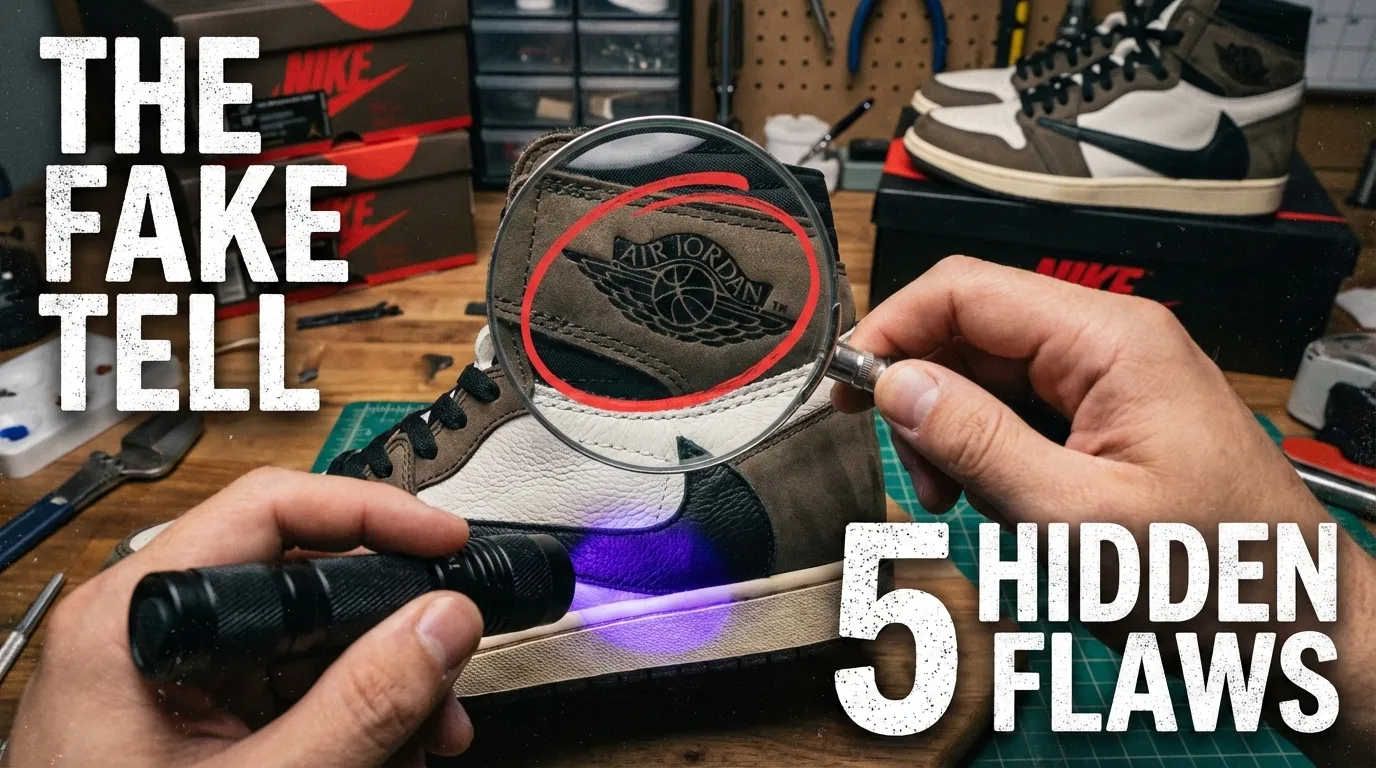
This is where professional sneaker authentication separates from casual inspection. These checks require a strong light source and ideally a macro lens or jeweler's loupe at 10x magnification.
Stitching Density and Consistency
Count the stitches per inch on panels where stitching runs close to an edge seam. Authentic sneakers maintain a precise, locked stitch count across the entire shoe. A single stitch that is visibly longer or shorter than its neighbors signals a replica factory running inconsistent thread tension—a common cost-cutting artifact.
Toe Box Shape
The toe box is the most reliable tell for Jordan 1 and Jordan 4 authentication. The authentic silhouette has a specific tapered curve engineered into the last. Replica toe boxes are frequently too tall, too wide, or aggressively rounded due to different tooling. This cannot be hidden by cleaning or photography.
Size Tag Typography
Inspect the "Made in China" or "Made in Vietnam" text on the interior tag under bright light. On replicas, individual letters frequently bleed into each other or show inconsistent baseline heights. On authentic pairs, the print is laser-sharp, with perfectly uniform letter heights and clean spacing between every character.
For a deeper dive into Jordan-specific markers, see our Jordan 1 fake vs. real legit check guide.
Phase 4: AI and Tech Tools for Sneaker Authentication in 2026
Human eyes have hard limits. The most thorough sneaker authentication workflow in 2026 combines physical inspection with technology to eliminate blind spots.
UV / Blacklight Inspection
Many authentic pairs carry invisible factory markings or exhibit specific fluorescent patterns on the midsole and insole that replica factories consistently miss. A UV flashlight costing under $15 can surface these markers in seconds. Check the midsole edges and the insole sock liner under blacklight before ruling anything out.
AI Shoe Scanner
A mobile shoe authenticator app is now the standard final step for professional legit checks. AI models analyze leather grain texture, logo color balance, and outsole tread geometry at a pixel level that exceeds human visual resolution. Apps like Sneaker AI deliver a data-driven verdict in under 60 seconds and generate an exportable report you can share with buyers or sellers.
RFID and NFC Chip Verification
Modern premium sneakers—including collaborations with luxury houses like Miu Miu and Prada—embed internal NFC chips linked to a verification record. If the chip does not respond to a tap or redirects to a broken link, the shoe's authenticity is immediately in question. This check takes five seconds and cannot be faked without access to the brand's proprietary authentication servers.
Want to understand how super-fakes specifically evade basic checks? Our guide on how to spot super-fake sneakers covers the advanced evasion tactics the top replica factories use in 2026.
Brand-Specific Sneaker Authentication Tips
General principles apply across all silhouettes, but each major model has unique tells that replica factories consistently get wrong. Here are the most actionable brand-specific markers.
Jordan 1 and Jordan 4
- Heel tab stitching: On authentic Jordan 1s, the heel tab is stitched with perfectly consistent spacing where it meets the heel counter. Replicas show a gap, pucker, or slight misalignment at this join.
- Jumpman debossing: The Jumpman logo on the Jordan 4 tongue should be cleanly pressed into the leather—not stamped flat or raised unevenly on one side.
- Toe box height: Jordan 4 replica toe boxes are almost universally 3–5mm too tall. Place the shoe on a flat surface and view the toe profile from eye level.
Nike Dunk
- Swoosh tip distance: Measure the distance from the tip of the Swoosh to the toe cap edge. On authentic Dunks, this distance is consistent left and right within 1mm. Replica Swooshes vary by 3–5mm between sides due to hand-placement assembly.
- Heel curvature: The authentic Dunk heel is a smooth, gradual arc from the collar down to the midsole. Replica heels often show a sharp angular transition near the midsole join—a molding artifact from lower-precision tooling.
New Balance 9060 / 1906R
- "N" logo stitching: Count the stitch rows filling the "N" embroidery. Authentic New Balance uses uniform, dense stitch fill. Replica versions show loose, uneven fill with visible gaps between rows.
- Midsole foam density: Authentic New Balance midsoles resist thumb pressure with a slight firmness. Replica foam compresses noticeably more easily due to lower-density EVA compounds that also degrade faster under wear.
For a full breakdown of New Balance authentication markers, see our New Balance women's sneakers guide.
The 2026 Sneaker Authentication Checklist
Save or print this quick-reference before any secondary market purchase.
Packaging
- [ ] Box label font weight matches authenticated reference photos
- [ ] SKU code verified against a trusted shoe identifier database
- [ ] Box cardboard is rigid and properly coated on exterior panels
Materials
- [ ] Suede changes shade when brushed in opposite directions
- [ ] Scent is neutral factory adhesive — not chemical or rubbery
- [ ] Reflective panels glow evenly and brightly under phone flash
Micro-Details
- [ ] Stitching density is consistent across all visible panels
- [ ] Toe box shape matches the correct silhouette profile
- [ ] Size tag typography is sharp with uniform letter heights
Tech Verification
- [ ] UV light reveals expected factory markings on midsole or insole
- [ ] AI shoe authenticator returns a verified authentic verdict
- [ ] NFC chip (if applicable) scans and resolves to a live verification page
Frequently Asked Questions About Sneaker Authentication
What is a legit check?
A legit check is a systematic review of a sneaker's physical characteristics — packaging, materials, stitching, shape, and markings — to determine whether it is authentic or a replica. Professional legit checks in 2026 also include AI-powered scanning for a data-driven second opinion.
How accurate is AI sneaker authentication?
Top-tier AI shoe authenticators achieve accuracy rates above 95% on well-documented silhouettes. They perform best when supplied with high-resolution photos of the box label, toe box, heel, size tag, and insole sock liner — all lit with consistent, direct light.
Can a certificate of authenticity be faked?
Yes. Certificates of authenticity issued by unknown third parties can be forged or purchased without a genuine shoe. Always verify the issuing platform's reputation and cross-check the certificate code against the platform's live digital verification system rather than trusting the paper alone.
What are the most commonly faked sneakers in 2026?
Jordan 1 Retros, Nike Dunks, Yeezy 350 V2s, and New Balance 9060s are the most replicated silhouettes as of 2026. These models have deep secondary markets and high resale premiums, making them the highest-volume targets for replica factories operating across Southeast Asia.
Is it safe to buy sneakers on eBay or Facebook Marketplace?
Yes — with proper due diligence. Always request the full photo set covering box, tag, toe box, heel, and insole, run a sneaker authentication check before any payment, and use buyer-protected payment methods that allow dispute resolution. Our guide on how to buy sneakers safely on eBay and Facebook Marketplace covers the full process step by step.
How do I avoid getting scammed when buying sneakers online?
The biggest protection is verification before payment. Never rely on seller-provided certificates alone, always authenticate the physical shoe or a full photo set independently, and understand the platform's buyer protection policy before committing. Read our full guide on how to not get scammed buying sneakers online for a platform-by-platform breakdown.
The Final Verdict: The Double-Blind Standard
Even the most experienced authenticators are subject to confirmation bias. When you want a pair to be real, your brain is primed to overlook red flags and rationalize inconsistencies.
The gold standard for sneaker authentication in 2026 is the Double-Blind Verdict:
- Run the shoe through an AI shoe authenticator for an instant, data-driven scan with no emotional stake in the result.
- Get a second opinion from a human expert who knows the specific factory quirks of that exact model, colorway, and production year.
If both verdicts agree, you have your answer. If they disagree, that disagreement is itself the finding—and you should walk away from the purchase until you have resolution.
Verification isn't just about avoiding a loss. It's about buying with complete confidence.
Ready to Verify Your Pair?
Don't leave it to chance. Use Sneaker AI's professional shoe identifier to get an instant AI verdict, or submit your photos for a 2-expert human legit check. Get your official Certificate of Authenticity in under 5 minutes.