How to Spot Fake Sneakers in 2026: Brand-by-Brand Detection Guide
Knowing how to spot fake sneakers is the single most valuable skill you can develop as a buyer in the 2026 resale market.
The replica industry has evolved beyond recognition. We are no longer dealing with cheap knockoffs carrying misspelled logos — we are dealing with UA (Unauthorized Authentic) batches produced with the exact same leather, the same digital molds, and sometimes the same overseas factories as the retail pairs. Whether you're buying on eBay, Facebook Marketplace, or at a local meetup, your gut feeling is no longer enough.
This guide is structured differently from a generic authentication walkthrough. After covering the five universal tests every buyer should run, we go brand by brand — because the fastest way to spot fake sneakers is knowing the specific tell for the exact model in your hands.
The 5 Universal Tests to Spot Fake Sneakers
These checks apply to every brand and every silhouette. Run all five before moving to brand-specific inspection.
Test 1: The SKU DNA Check
Before you touch the shoe, read the box. The style code printed on the box label must perfectly match the code on the interior size tag. Use a shoe identifier app to cross-reference that code against official brand databases — it will return the correct model name, colorway, and release year. A mismatch between box and tag, or a code that returns the wrong colorway, is an immediate disqualifier.
On authentic Nike sneakers and Jordans, the font kerning on the box label is laser-precise — consistent spacing between every letter in the colorway name. Replica boxes frequently show "wavy" text, letters that are slightly too thin, or spacing that varies across the label.
Test 2: The UV Blacklight Test
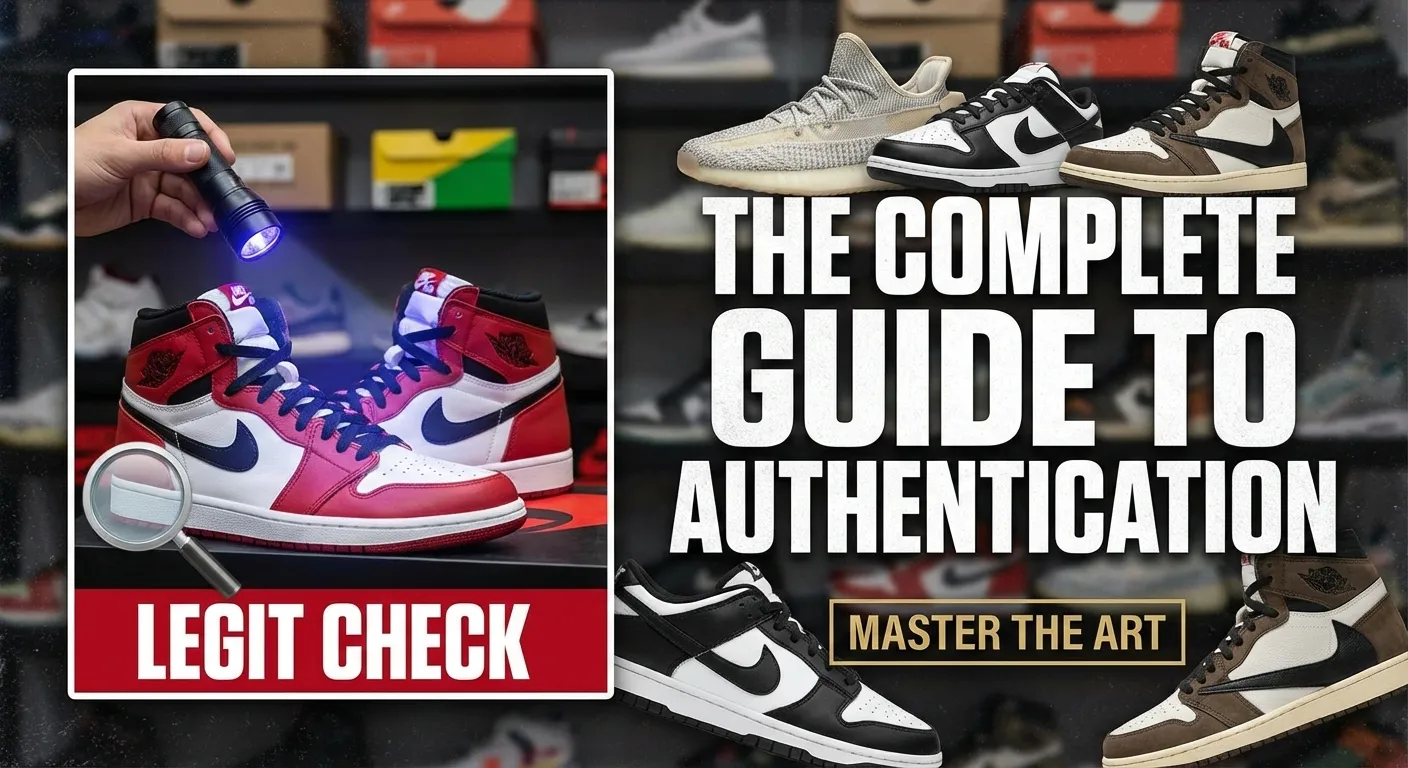
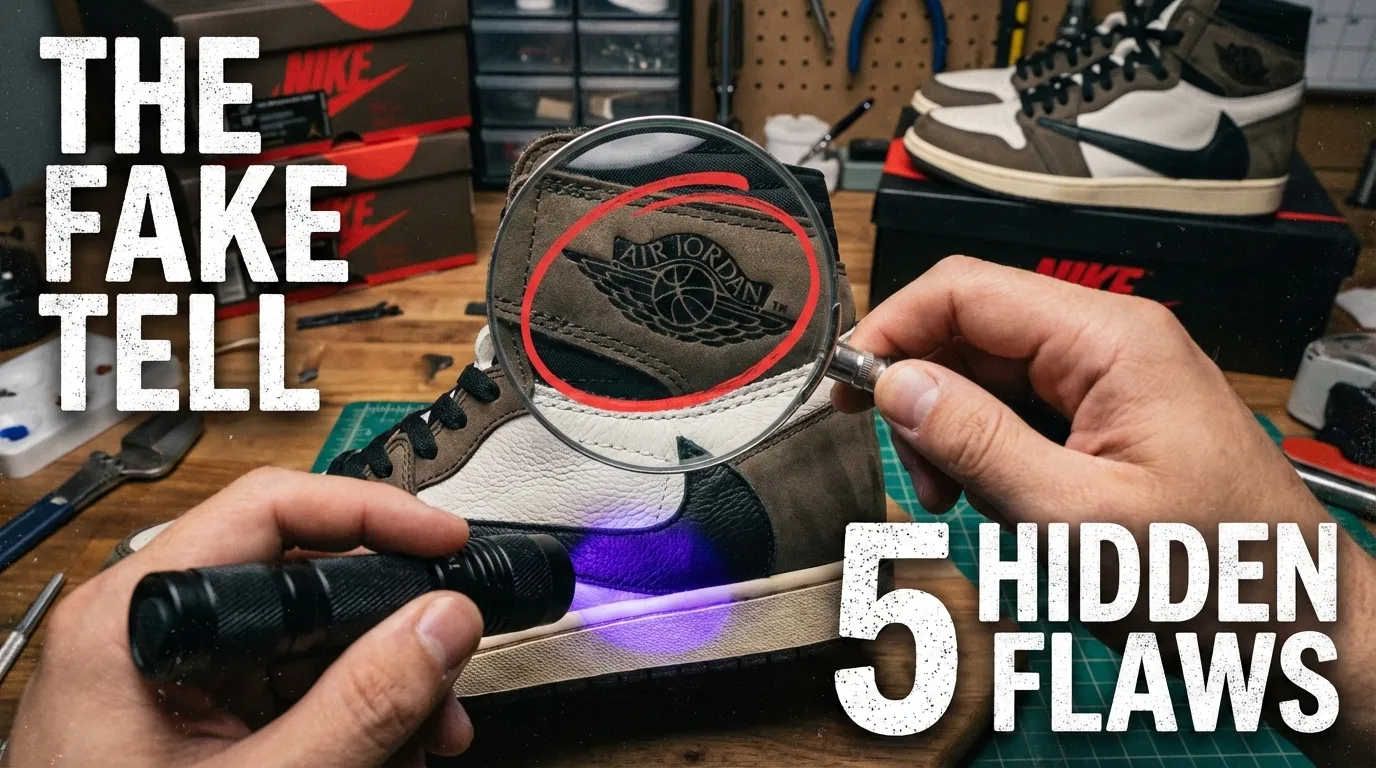
A UV flashlight is a $10 investment with outsized returns for spotting fake sneakers. Authentic factories maintain clean assembly floors. Replica factories use marker pens to guide workers on stitching paths — and those marks glow under blacklight. Run the light along the midsole edges and the interior panels. Glowing dotted lines or smeared glue residue are signature replica artifacts.
On current Nike sneakers, the stitching thread and leather panels react differently to UV exposure — one glows faintly, the other stays matte. If the entire shoe glows uniformly or the entire shoe shows no UV reaction at all, the materials are inconsistent with authentic production.
Test 3: The Smell Test
Authentic sneakers carry a neutral, slightly sweet factory adhesive scent — consistent across every legitimate pair from a given production run. Replicas are rushed through assembly and sealed before adhesives fully off-gas. Open the box and take a deliberate sniff before touching anything. A sharp chemical odor, industrial glue smell, or anything resembling spray paint is a reliable fake indicator.
Test 4: The Material and Feel Test
Run your thumb across any suede panel. Authentic suede visibly changes shade when brushed — lighter in one direction, darker in the other — because of genuine fiber nap. Replica suede stays flat and uniform because it is typically a coated synthetic material with no real nap structure.
For leather panels, bend a small section gently between your fingers. Authentic full-grain leather shows a natural flex and slight crease that relaxes back. Replica bonded leather creases stiffly and may show surface cracking even on "new" pairs.
Test 5: The AI Scan
The human brain sees what it wants to see. If you want a pair badly enough, you will rationalize away inconsistencies. A sneaker scanner app does not have that problem. AI authentication analyzes stitching density, logo color hex values, and sole geometry against a database of verified authentic pairs — surfacing discrepancies that are physically invisible to the naked eye. Run this as your final check before any purchase decision.
For a complete process-based authentication system, see our full sneaker authentication guide.
How to Spot Fake Jordan 1s and Jordan 4s
Jordans are the most replicated sneakers on the secondary market. Here are the model-specific tells.
Jordan 1 — Key Tells
- Toe box curve: The Jordan 1 toe box has a specific tapered arc. Replicas are consistently too tall and too boxy — place the shoe on a flat surface and view the profile from eye level.
- Heel tab stitching: Where the heel tab meets the heel counter, authentic Jordan 1s show tight, even stitching with no gap. Replicas show a pucker or visible seam separation at this join.
- Swoosh edge finish: The edge of the Swoosh on a Jordan 1 should be cleanly cut with no fraying or roughness. Run your thumbnail lightly along the edge — fakes often feel slightly serrated.
- Nike Air insole font: The text on the insole should be crisp and uniformly bold. Replica insoles often show ink that has slightly bled into the foam.
Jordan 4 — Key Tells
- The Cage Mesh Test: This is the most reliable single check for Jordan 4 authentication. The mesh panels on the sides of the Jordan 4 must run parallel to the lace eyelets. If the mesh runs vertically or at an angle, it is a replica — no exceptions.
- Jumpman tongue debossing: The Jumpman logo on the tongue should be cleanly pressed into the material at a consistent depth. Replica debossing is often too shallow, too deep, or uneven across the logo.
- Toe box height: Authentic Jordan 4 toe boxes are lower and more streamlined than replicas, which are almost universally too tall due to different last tooling.
For a detailed side-by-side breakdown, see our Jordan 1 fake vs. real legit check guide.
How to Spot Fake Nike Dunks
The Nike Dunk is the second most replicated silhouette of the 2020s, and replica factories have had years to refine their tooling. The tells are subtle.
- Swoosh tip distance: Measure the gap between the tip of the Swoosh and the toe cap edge. On authentic Dunks, this measurement is consistent left and right within 1mm. Replicas show variation of 3–5mm because the Swoosh is positioned by hand in lower-precision factories.
- Heel curvature: The authentic Dunk heel is a smooth, continuous arc from the collar down to the midsole. Replica heels show a distinct angular break near the midsole join — a molding artifact from cheaper tooling.
- Tongue label stitching: The rectangular label on the Dunk tongue should be stitched with four perfectly parallel lines, all the same stitch density. Replica labels are often slightly rotated or show irregular stitch spacing on one side.
- Outsole flex pattern: Bend the Dunk sole gently and look at the flex points. Authentic Dunk outsoles flex cleanly along the engineered groove lines. Replica outsoles flex across them, indicating a different rubber compound.
How to Spot Fake Yeezys (350 V2)
The Adidas Yeezy 350 V2 is one of the most extensively replicated sneakers ever made, and in 2026 some replica versions are technically sophisticated enough to fool casual inspection.
- Primeknit pattern density: The 350 V2's Primeknit upper has a specific knit density that varies by zone across the shoe. Use a macro lens or jeweler's loupe — replica Primeknit often shows a uniform knit density across the entire upper, while authentic pairs show visible variation.
- Boost sole texture: Real Boost pellets have an irregular, organic shape and cluster pattern. Replica Boost uses a more uniform, regularly spaced pellet pattern that looks "too perfect" up close.
- SPLY-350 text: The side stripe text on colorways that include it should be precisely straight. Replica text frequently runs slightly uphill or downhill across the stripe length.
- The "3M stripe" reflectivity: On colorways with reflective stripes, the authentic 3M material produces a bright, even glow under flash. Replicas produce a dull, grainy, or patchy reflection.
How to Spot Fake New Balance Sneakers (1906R and 9060)
New Balance authentication is heavily focused on material quality — particularly the "N" logo embroidery and the midsole foam compound.
New Balance 1906R — Key Tells
- TPU heel cage rigidity: The 1906R features a complex TPU heel cage that is structurally rigid on authentic pairs. Press your thumb firmly against the rear cage section. Authentic pairs resist clearly. Replica cages use softer, cheaper plastic that compresses visibly under moderate thumb pressure.
- "N" logo stitch fill: Count the stitch rows filling the "N" embroidery. Authentic New Balance uses dense, uniform stitch fill with no visible gaps between rows. Replica "N" logos show loose, irregular fill with gaps that catch light inconsistently.
New Balance 9060 — Key Tells
- Midsole color consistency: The 9060 midsole uses a specific shade that is consistent from the toe to the heel on authentic pairs. Replicas frequently show a slight color gradient — darker toward the heel — due to inconsistent foam pigmentation.
- Outsole tread depth: Authentic 9060 outsole lugs have a specific depth and edge sharpness. Replica lugs are often shallower and have rounded edges due to lower-precision mold tooling.
How to Spot Fake Puma Speedcats (2026)
The Puma Speedcat became one of 2026's most replicated lifestyle shoes due to its viral cultural moment. Its slim silhouette is also one of the hardest for replica factories to nail.
- Toe box proportions: The authentic Speedcat has a dramatically slim, aerodynamic toe box profile. Replicas are consistently too chunky at the toe and too "bottom-heavy" when viewed from the side — the midsole appears thicker than it should.
- Suede panel seams: The Speedcat's suede panels meet at very precise seam lines. On replicas, these seams are slightly misaligned — most visible at the toe cap join.
- Puma formstrip stitching: The formstrip (the brand's equivalent of the Swoosh) should be stitched with consistent edge distance across its full length. Replica formstrips often show variable stitch-to-edge distance, widening or narrowing as it curves.
For broader context on how super-fakes evade standard inspection, see our guide on how to spot super-fake sneakers.
The Master Fake Sneaker Detection Checklist
Use this before every secondary market purchase.
Universal Checks
- [ ] SKU on box label matches SKU on interior size tag exactly
- [ ] Style code verified in a shoe identifier database — correct model and colorway
- [ ] Box label font kerning is sharp and consistent, no wavy or bleeding letters
- [ ] UV blacklight reveals no glowing guide marks or glue residue
- [ ] Suede panels change shade when brushed in opposite directions
- [ ] Leather panels flex and recover naturally — no stiff cracking on new pairs
- [ ] Scent is neutral factory adhesive — no chemical or rubber-burn odor
- [ ] 3M reflective panels (if present) glow evenly under phone flash
- [ ] AI shoe authenticator returns a verified authentic verdict
Brand-Specific (Run the Relevant Section)
- [ ] Jordan 4: cage mesh runs parallel to lace eyelets
- [ ] Jordan 1/4: toe box height matches authenticated reference photos
- [ ] Nike Dunk: Swoosh tip distance is consistent left-to-right within 1mm
- [ ] Yeezy 350 V2: Primeknit density varies by zone — not uniform across upper
- [ ] New Balance: TPU heel cage resists firm thumb pressure without flexing
- [ ] Puma Speedcat: toe box is slim and aerodynamic, not bottom-heavy
Frequently Asked Questions About Spotting Fake Sneakers
How do I spot fake Jordan 1s quickly?
The fastest single check is the toe box profile viewed from the side at eye level. Authentic Jordan 1s have a tapered, lower-profile toe. Replicas are consistently too tall and boxy. Follow up with the heel tab stitching check for confirmation.
Can you spot fake sneakers from photos alone?
Yes, with high-resolution photos of the box label, size tag, toe box, heel, and outsole. An AI shoe authenticator can analyze these photos before you commit to a purchase and will catch discrepancies in color values and geometry that are difficult to see with the naked eye.
What are the easiest fake sneakers to spot?
Budget replica tiers (often called "A1 batch" or "1:1 batch") are relatively easy to spot through the SKU check, smell test, and toe box profile. The difficulty comes with factory-direct "super-fakes" that use authentic materials — those require UV testing, AI scanning, and brand-specific micro-detail checks.
What are the hardest fake sneakers to spot in 2026?
High-tier Jordan 4 replicas and Yeezy 350 V2 "Milk batch" super-fakes are currently the hardest to authenticate by eye alone. Both require UV testing, Primeknit density analysis, and AI verification for a confident verdict.
Is it illegal to sell fake sneakers?
Yes. Selling counterfeit goods is a federal crime under the Lanham Act in the United States and carries equivalent criminal penalties in most markets worldwide. Buyers who unknowingly receive fakes are protected — sellers who distribute them are not.
What should I do if I bought fake sneakers without knowing?
Document everything immediately with photos. If you bought through eBay, open a case under "Item Not As Described" — buyer protection applies. For Facebook Marketplace with PayPal Goods and Services, file a dispute through PayPal. For cash or unprotected payment transactions, contact local consumer protection authorities. See our full guide on how to not get scammed buying sneakers online for platform-specific dispute steps.
The golden rule for spotting fake sneakers in 2026 is simple: if you cannot verify it with at least two independent methods, do not buy it. The resale market has honest sellers, but it is also the primary income channel for sophisticated counterfeit operations. A professional shoe identifier and an AI sneaker authentication scan are not extra steps — they are the minimum standard for buying with confidence.
Don't Get Burned by a Super-Fake
Replica quality is at an all-time high. Use Sneaker AI's advanced shoe identifier to scan for microscopic flaws, or get a professional legit check from our experts in under 10 minutes. Secure your fit today.