Jordan 1 Legit Check (2026): 8 Checks That Separate Fake vs. Real
The Jordan 1 legit check is the most important authentication skill in the secondary sneaker market — because the Air Jordan 1 is the most replicated shoe in history.
The Chicago, Bred, Royal Toe, and high-heat collaborations routinely trade at $400–$2,000+ on the secondary market. That premium is exactly what funds the replica industry's investment in accuracy. The "LJR" and "PK" factory batches of 2026 are the closest replicas have ever come to authentic pairs — produced with the same leather grades, the same hardware, and sometimes the same digital molds as retail production.
"Pretty sure" is no longer a good enough verdict when your money is on the line. This guide covers the complete Jordan 1 legit check process: 8 authentication checks in order of reliability, the specific tells for the most-faked colorways, and the point at which AI or professional authentication is the right call.
Check 1: The Hourglass Heel Profile
View the shoe from directly behind at eye level. An authentic Jordan 1 has a distinct hourglass silhouette — wider at the collar, narrowing through the mid-section of the heel counter, and widening again at the midsole base.
The fake tell: Replica Jordan 1s consistently produce a boxy, rectangular heel profile because the last geometry used in replica factories is incorrect. If the back of the shoe looks like a straight-sided rectangle rather than a tapered hourglass, it is a replica — no further investigation needed.
This is the single fastest check for Jordan 1 authentication and can be performed from photos if the seller provides a clean heel-straight-on shot. Make it the first request in any photo set you ask for.
Check 2: The Wings Logo Embossing
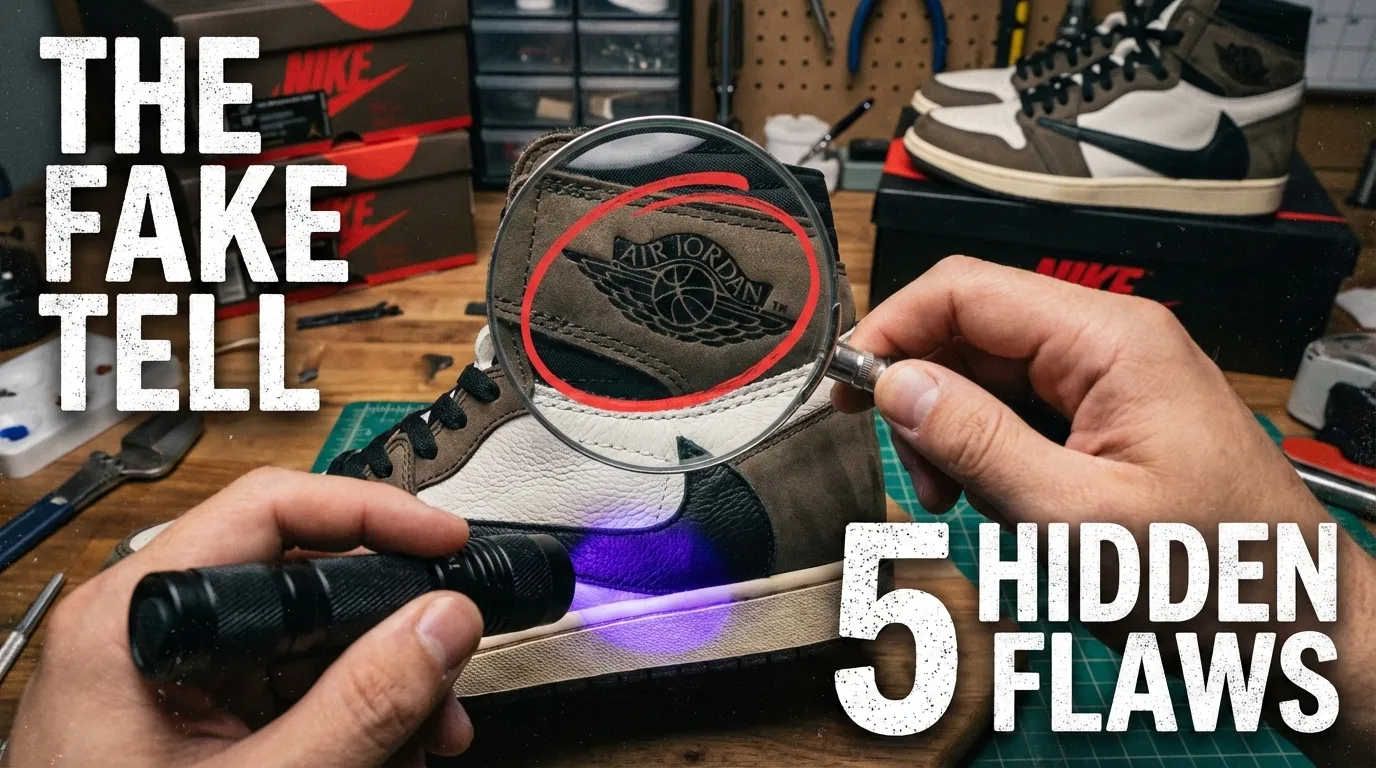
The "Air Jordan" Wings logo on the ankle is one of the most scrutinized details in Jordan 1 legit checks — and one of the most reliable.
On authentic pairs, the Wings logo is deeply debossed into the leather. Run your fingernail across it: the ridges should be clearly palpable, with a depth you can feel without looking. The logo panel should also sit flat against the shoe rather than showing any lifting at the edges.
The fake tell: Replicas produce two distinct failure modes here. Lower-tier fakes use a printed or heat-transferred logo with no tactile depth — it looks correct in photos but feels flat to the touch. Higher-tier replicas deboss the logo but at insufficient depth, leaving a shallow impression that catches light differently than an authentic embossing.
The "R" and "D" Test: On authentic Jordan 1 Wings logos, the letters "R" and "D" in "JORDAN" are physically touching at their base. This is a font characteristic of the authentic Nike-licensed type. On replicas, these letters often have a visible gap between them — check under magnification or a macro phone lens.
Check 3: The Toe Box Shape and Height
The toe box is the most consistently wrong element across all replica Jordan 1 batches, including 2026's most sophisticated LJR and PK factory output.
Authentic Jordan 1 toe boxes have a specific, tapered arc when viewed from the side — the profile curves gently upward from the toe tip before dropping down to meet the midsole. The height is deliberately restrained.
The fake tell: Replica toe boxes are almost universally too tall. The internal foam structure in replica factories uses a different last, resulting in a toe box that appears inflated or "puffed up" when compared to authentic pairs. This is most visible from the side profile — place the shoe on a flat surface and photograph from directly lateral at eye level. Compare against authenticated reference photos for the specific colorway.
Check 4: The Heel Tab Stitching
The heel tab — the loop at the back of the collar — is attached to the heel counter through a series of stitches. The pattern and consistency of these stitches is a reliable authenticity indicator.
On authentic Jordan 1s, the heel tab stitching is tight, uniform, and creates a clean visual join between tab and shoe. The thread spacing is consistent across the full width of the attachment point.
The fake tell: Replica heel tab stitching shows two common failure modes: a visible gap or pucker where the tab meets the heel counter, and variable stitch spacing that widens or narrows across the attachment width. Both are artifacts of lower-precision sewing machinery.
Check 5: The Corner Stitch and Swoosh Relationship
This is where most Jordan 1 legit check guides get it wrong — and where knowing the correct information is itself an authentication signal.
A widespread myth claims that authentic Jordan 1 stitching should never touch the Swoosh. This is outdated and incorrect. Nike's quality control involves human operators on a production line, and there is documented variance in where the corner stitching lands relative to the Swoosh across authentic pairs.
What actually matters: The thread quality and consistency. Authentic Jordan 1 stitching uses a specific thread weight with a matte finish that does not reflect light differently from the surrounding leather. Replica factories frequently use a thinner, shinier thread that catches light distinctly — particularly visible under UV or flash photography. The thread should visually disappear into the stitching channel rather than sitting on top of it.
Check 6: The Toe Box Leather Spring Test
This is a tactile check that cannot be performed from photos — it requires the physical shoe in hand.
Press down firmly on the center of the toe box with your thumb and release. On authentic Jordan 1s, the high-quality full-grain leather springs back to its original shape almost immediately — within one to two seconds.
The fake tell: Replica toe boxes use inferior bonded leather or synthetic leather that either stays indented after thumb pressure or "crunches" inward with a sound and feel inconsistent with genuine leather. If the toe box depresses easily and recovers slowly, the material is not authentic.
Check 7: The Tongue Tag Typography
The tongue tag is one of the most densely informative elements of a Jordan 1 legit check — it contains the Nike Air branding, the size, the country of manufacture, and in many cases a style code.
On authentic Jordan 1s, the tongue tag printing is executed with laser-sharp precision. The Nike Air logo, size numerals, and "Made in" text all show perfectly uniform stroke widths and consistent ink density across the full print area.
The fake tell: Replica tongue tags fail in two consistent ways. First, ink bleed — letters appear slightly fuzzy or "haloed" where ink has seeped into the tag fabric. Second, the font stroke weights are incorrect — often too bold across the "Made in" text or too thin in the size numerals. These failures are most visible under a bright direct light source at a slight angle to the tag surface.
Check 8: The Size Tag SKU and Font
The size tag is the shoe's "DNA card" — and every field on it must be correct.
The style code on the size tag must exactly match the style code on the box label. Use a shoe identifier app to cross-reference the style code against official Nike databases. It will return the correct colorway name, silhouette, and release year. A code that returns a different colorway is an immediate disqualifier.
Font specifics: The "Made in China" or "Made in Vietnam" text on authentic size tags is printed at a specific, consistent font weight. Letters have uniform height baselines and clean separation between characters. Replica size tags show variable baseline alignment — individual letters sit slightly higher or lower than their neighbors — and inconsistent character spacing, particularly around the "i" and "l" characters which replicas often render too wide.
The Most Faked Jordan 1 Colorways in 2026
Not all Jordan 1 colorways attract equal replica investment. Factories prioritize colorways with the highest resale premiums.
Highest replica risk (professional authentication recommended):
- Chicago (555088-101) — the defining Jordan 1 colorway, commands $600–$1,500+ resale
- Bred Toe (555088-610) — high sustained demand, well-documented in replica catalogs
- Royal Toe (575441-041) — premium resale, complex colorblocking that replicas struggle with
- Travis Scott collaborations — $800–$3,000+ resale, highest replica investment of any Jordan 1
Moderate replica risk (thorough manual check + AI scan):
- Court Purple colorways
- University Blue
- Mocha (Jordan 1 Low)
- Chicago Lost and Found
Lower replica risk (standard manual check sufficient):
- General release colorways below $200 resale premium
The LJR and PK Batch Problem
In 2026, the most sophisticated replica Jordan 1s come from two factory operations referred to in collector communities as "LJR" and "PK" batches. Understanding what makes them difficult to authenticate is itself useful.
Both operations source materials that match authentic Nike leather grades in tactile quality and appearance. Both produce Wings logo debossing that passes casual inspection. Both use correct toe box colorblocking and hardware.
Where they consistently fail: the heel hourglass geometry (Check 1), the "R and D touching" detail in the Wings logo (Check 2), the tongue tag ink quality (Check 7), and the size tag font baseline consistency (Check 8). These four checks, applied together, identify LJR and PK batch replicas that defeat all other casual inspection.
For any pair with a resale premium above $500, the combination of AI scanning and human expert review is the only authentication standard that closes the remaining gap.
Jordan 1 Legit Check Checklist
Use this for every Jordan 1 purchased outside of verified retail.
Visual (Can Be Done From Photos)
- [ ] Heel profile viewed from behind — hourglass shape, not rectangular
- [ ] Toe box height — tapered arc, not inflated or puffed
- [ ] Wings logo — deeply debossed, "R" and "D" touching at base
- [ ] Tongue tag — sharp print, no ink bleed, correct stroke weights
- [ ] Size tag — SKU matches box label, consistent letter baseline alignment
- [ ] SKU verified in shoe identifier database — correct colorway returned
Physical (Requires the Shoe in Hand)
- [ ] Wings logo ridges palpable under fingernail pressure
- [ ] Toe box leather springs back within 1–2 seconds of thumb pressure
- [ ] Heel tab stitching is uniform with no gap at the join
- [ ] Corner stitching thread is matte, not reflective under flash
Technology
- [ ] AI shoe authenticator returns verified authentic verdict
- [ ] UV blacklight reveals no guide marks on midsole or insole
Frequently Asked Questions About Jordan 1 Authentication
What is the easiest way to spot a fake Jordan 1?
The heel profile viewed from behind is the fastest single check. Authentic Jordan 1s have a clear hourglass shape — wide at the collar, narrowing through the heel counter, widening at the midsole. Replica heels are consistently rectangular. This check takes five seconds and works from a photo.
Are Jordan 1 Mids harder or easier to authenticate than Jordan 1 Highs?
Jordan 1 Mids share most of the same authentication checks as Highs but have a lower collar that makes the hourglass heel check less pronounced. The Wings logo, size tag, toe box, and tongue tag checks are identical. LJR and PK batch replicas exist for both.
How accurate is AI authentication for Jordan 1s?
AI shoe authenticators are highly accurate on Jordan 1s because the model has one of the most extensively documented authentic reference databases in sneaker authentication. AI analysis is particularly strong at detecting LJR and PK batch replicas through logo geometry measurement and size tag font analysis — checks that are difficult to perform reliably by eye.
Is the Jordan 1 really the most faked sneaker in history?
By volume of replica units produced and the number of documented factory operations dedicated to it, yes. The Jordan 1's sustained cultural relevance since 1985, its broad colorway range, and its consistent premium resale pricing make it the highest-priority target for replica investment globally.
What should I do before buying a Jordan 1 for over $500?
Run a full manual check using all eight points in this guide, submit photos to an AI shoe authenticator for an instant analysis, and for pairs above $800, use a professional two-expert sneaker authentication service before payment. The cost of authentication is a fixed expense; the cost of buying a high-tier fake is not recoverable.
Can replica Jordan 1s fool authenticated resale platforms?
StockX, GOAT, and eBay Authenticity Guarantee have all reported instances of sophisticated replicas passing initial inspection — particularly LJR and PK batch pairs. These platforms have improved their verification protocols, but no platform guarantees 100% accuracy. For the highest-value pairs, independent authentication before purchase provides an additional verification layer. See our complete sneaker authentication guide for the full process.
The Jordan 1 legit check is a learnable, repeatable skill. The eight checks in this guide — applied systematically rather than selectively — cover every failure mode present in 2026's most sophisticated replicas. Pair physical inspection with AI verification for any pair above $200, and add professional review for anything above $500.
The replica market's entire strategy depends on buyers moving fast. Slow down, and the process wins.
Is Your Jordan 1 the Real Deal?
Don't risk your reputation on a maybe. Use our specialized Jordan 1 sneaker scanner for an instant AI scan, or get the ultimate peace of mind with a 2-expert legit check in under 5 minutes.