How to Buy Sneakers Safely on eBay & Facebook Marketplace (2026)
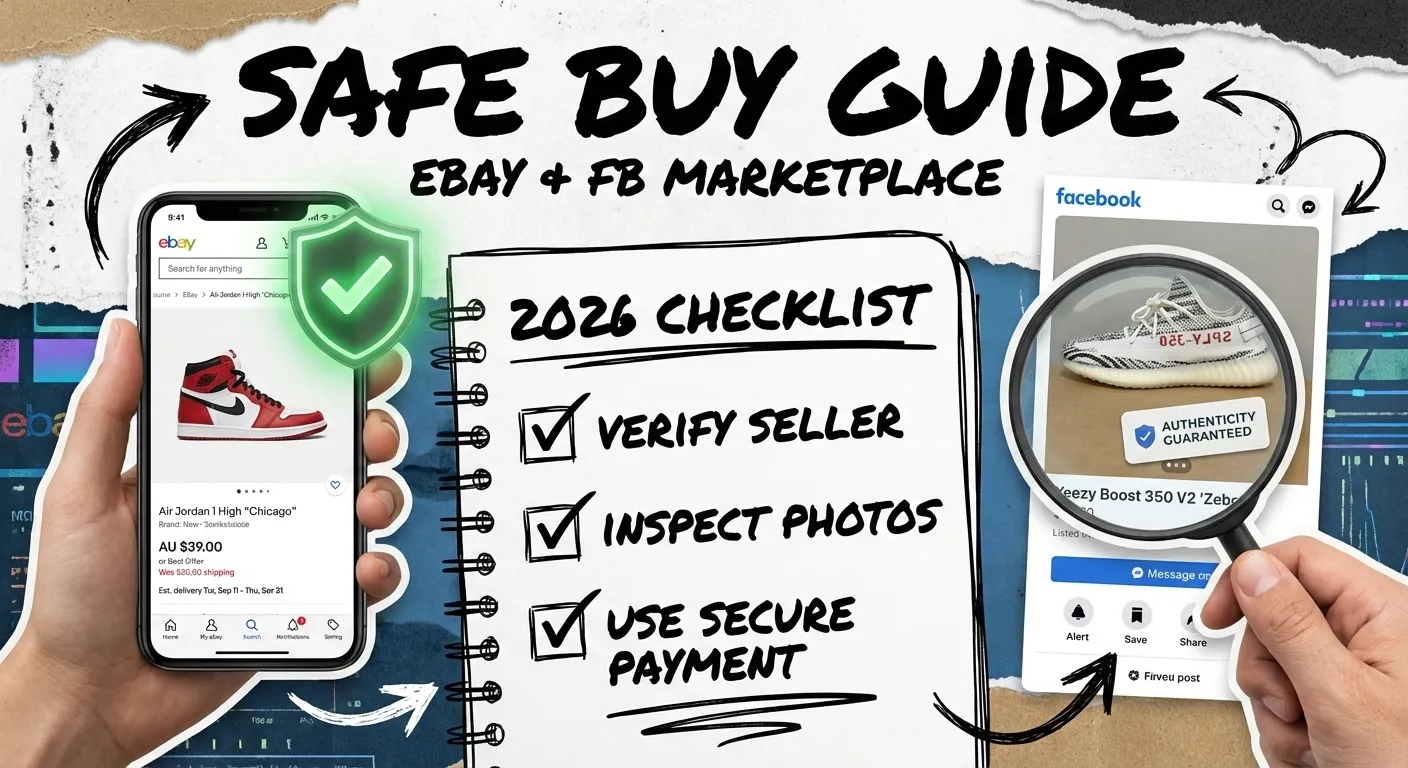
Knowing how to buy sneakers safely on eBay and Facebook Marketplace is the difference between landing a grail and losing hundreds of dollars to a scammer.
The secondary sneaker market generates billions of dollars annually, and with that volume comes a parallel economy of fakes, fraud, and pressure tactics designed to make you act before you think. There's nothing quite like finding a pair of sold-out New Balance 2002Rs or pristine Nike Dunks at a price that fits your budget—but one wrong click or one rushed meetup and you're the owner of a $300 paperweight.
This guide covers exactly how to buy sneakers safely on both platforms: how to read listings, spot red flags, protect your payment, and authenticate on the spot using tools the pros use.
How to Buy Sneakers Safely on eBay in 2026
eBay has invested heavily in winning back the sneaker community, and its Authenticity Guarantee program is the centerpiece of that effort. When you see the blue checkmark on a listing, the shoes are routed to a third-party verification facility before they ship to you. For straightforward purchases above the qualifying price threshold, this is the closest thing to a guaranteed-safe transaction on the platform.
But the Authenticity Guarantee has limits worth understanding before you rely on it.
What eBay's Authenticity Guarantee Covers
Only sneakers above a certain price point qualify for the program—typically $150 or more depending on the category. If you're buying a $90 pair of "lightly used" Dunks, you are outside the program's scope and fully responsible for authenticating the shoe yourself.
How to Read eBay Seller Feedback Correctly
A seller with 1,200 five-star reviews sounds trustworthy—until you check what they were selling. Click into "Feedback as Seller" and filter for mentions of sneakers specifically. A seller who built their reputation moving vintage electronics or collectibles has no verified track record with footwear. Scammers exploit this trust gap constantly.
Look for these signals in feedback before buying:
- Recent reviews from buyers who mention the specific brand or model you're purchasing
- Any neutral or negative feedback mentioning "not as described" or "fake"
- Account age relative to listing volume — high volume on a new account is a red flag
- Whether the seller ships from the country they claim to be in
Price Floor Rules on eBay
On eBay, market-rate pricing is your first authentication tool. Search the "Sold Listings" filter to see what authentic pairs of your exact size and colorway actually sold for in the last 30 days. If a listing is more than 20–25% below that average with no condition explanation, treat it as a potential fake or a bait-and-switch listing.
How to Buy Sneakers Safely on Facebook Marketplace
Facebook Marketplace is where the best deals in the secondary market live—and where the highest concentration of scams operate. Because there is no platform middleman, the responsibility of sneaker authentication falls entirely on you as the buyer.
Red Flag #1: The Price That Doesn't Add Up
If the going market rate for a pair is $400 and the seller is asking $180 with a vague explanation, it is a scam. Legitimate sellers price to market or slightly below to move inventory quickly. The "I need rent money" story is a social engineering script designed to trigger your sympathy and suppress your skepticism.
Red Flag #2: Profile Age and Activity
Check the seller's Facebook profile before responding. An account created in the last few months, with few friends, no timeline activity, and no Marketplace history is a high-risk indicator. Legitimate private sellers have digital footprints. Anonymous-looking profiles are often burner accounts used for scam cycles.
Red Flag #3: Stolen or Digitally Tagged Photos
A common scam involves taking high-quality photos from a legitimate reseller's listing and photoshopping a paper tag with the scammer's username onto the shoe. Examine the tag closely: does the lighting and shadow on the tag match the lighting on the shoe itself? If the tag looks digitally composited, it almost certainly is.
Run a reverse image search on the listing photos using Google Lens or TinEye. If the same photos appear on StockX, GOAT, or another seller's active listing, you are looking at a stolen image scam.
Red Flag #4: Pressure to Move Fast
Scammers manufacture urgency. "I have three other people interested" or "I need to sell by tonight" are pressure tactics designed to override your verification process. Authentic sellers with a legitimate pair are happy to answer questions and wait for a reasonable response time.
Safe Payment Methods When Buying Sneakers Online
Payment method is your last line of financial protection when you buy sneakers on platforms without built-in escrow.
PayPal Goods and Services — Use This
PayPal's "Goods and Services" option is the only payment method that gives you a formal dispute pathway if the item is not as described or never arrives. The seller pays a small fee, which is why scammers always ask for "Friends and Family" instead. If a seller refuses to accept PayPal Goods and Services, walk away from the transaction.
Zelle, Venmo Friends and Family, CashApp — Avoid These
These apps offer zero buyer protection. Once the money leaves your account, it is gone. If the shoes turn out to be fakes—or if the seller simply takes your payment and disappears—your bank cannot reverse the transaction and the app's terms of service explicitly exclude fraud recovery for peer-to-peer payments sent voluntarily.
Cash at In-Person Meetups
Cash is acceptable for in-person transactions only—and only after you have completed a full legit check on the shoe. Never hand over cash before you have the shoe in your hands and have finished authenticating it. If the seller wants cash upfront "to hold" the pair, decline.
How to Authenticate Sneakers Before Buying
Whether you're on eBay or meeting a seller in a parking lot, sneaker authentication is the skill that protects your money. In 2026, this means combining physical inspection with AI tools.
SKU Verification
Every authentic sneaker carries a style code on the box label and the interior size tag. These two codes must match each other and must return the correct model and colorway when searched in a shoe identifier database. A mismatch between box and tag is an immediate disqualifier—no exceptions.
Photo-Based Pre-Purchase Check
Before committing to a purchase on eBay or Facebook Marketplace, request a specific photo set from the seller:
- Box label (full shot showing SKU)
- Size tag interior
- Toe box straight-on
- Heel straight-on
- Insole sock liner
- Outsole
Run these photos through an AI shoe authenticator before agreeing to purchase or meet. Sellers with authentic pairs will have no objection to providing this documentation. Sellers who push back or claim they "don't have the box" are signaling that the shoe may not pass inspection.
In-Person AI Scan
At an in-person meetup, use a mobile sneaker scanner app to get a real-time verdict. This gives you an objective, data-backed answer that removes social pressure from the equation. Instead of relying on memory of what an authentic Jordan 4 size tag looks like, you have a 60-second AI analysis in your hand.
For a complete breakdown of what to check physically during authentication, see our full sneaker authentication guide.
In-Person Meetup Safety Protocol
The parking lot meetup is where most secondary market mistakes happen. You're face to face with the seller, you feel the social pressure of the moment, and rushing through authentication feels awkward.
Choose a Safe Location
Always meet in a public, well-lit location during daylight hours. Police station parking lots are an increasingly popular option—many departments explicitly invite this use for marketplace transactions.
Take Your Time
You are spending real money. Take the full time you need to inspect the shoe, run your authentication tools, and make a confident decision. A legitimate seller will wait. If the seller becomes impatient, hostile, or attempts to rush you, that behavior is itself a red flag.
Bring a Second Person
For transactions above $200, bring someone with you. Two sets of eyes catch more details, and the social dynamic of a group reduces pressure tactics from bad-faith sellers.
If you're new to physical inspection, our guide on how to spot fake sneakers covers every checkpoint from packaging to micro-details.
The Complete Sneaker Buying Safety Checklist
This is the checklist the title promised. Use it before, during, and after every secondary market purchase.
Before You Contact the Seller
- [ ] Check sold listings for real market price on your size and colorway
- [ ] Verify the seller's feedback history specifically mentions sneakers
- [ ] Run listing photos through reverse image search (Google Lens or TinEye)
- [ ] Check the seller's profile age, friend count, and Marketplace history
During Negotiation
- [ ] Request full photo set: box label, size tag, toe box, heel, insole, outsole
- [ ] Run photos through an AI shoe authenticator before agreeing to meet
- [ ] Confirm payment method upfront (PayPal G&S or cash in-person only)
- [ ] Do not respond to urgency pressure or limited-time claims
At the In-Person Meetup
- [ ] Meet in a public, well-lit location during daylight
- [ ] Inspect box label SKU against size tag SKU
- [ ] Run AI sneaker scanner for a real-time verdict
- [ ] Check materials: suede nap, reflective panels, smell
- [ ] Examine toe box shape and stitching density
At Payment
- [ ] Hand over cash only after completing authentication
- [ ] Never use Zelle, Venmo F&F, or CashApp for sneaker transactions
- [ ] For eBay: verify the Authenticity Guarantee badge is present before checkout
Frequently Asked Questions
Is eBay safe for buying sneakers?
Yes, with conditions. Sneakers covered by eBay's Authenticity Guarantee program (generally $150+) are routed through third-party verification before delivery, making them a reliable purchase. For cheaper listings outside the program, you are responsible for authentication and should request photos for AI verification before committing.
What is the safest payment method when buying sneakers on Facebook Marketplace?
PayPal Goods and Services is the safest option for online transactions because it includes formal dispute resolution. For in-person meetups, cash after a successful authentication check is acceptable. Never use Zelle, Venmo Friends and Family, or CashApp—these offer no buyer protection.
How do I know if a Facebook Marketplace sneaker listing is fake?
Check for four red flags: a price significantly below market value, a recently created seller profile with little activity, photos that appear in other listings when reverse image searched, and a seller who pressures you to act quickly or refuses to provide additional photos.
Can I authenticate sneakers from photos alone?
Yes, with high-resolution photos covering the key checkpoints: box label, size tag, toe box, heel, insole, and outsole. AI shoe authenticators can analyze these photos before you commit to a purchase or meetup. This pre-purchase check is one of the highest-value steps you can take.
What should I do if I receive fake sneakers from eBay?
Open a return case immediately through eBay's Resolution Center under "Item not as described." eBay's buyer protection policy covers this scenario. If the shoes were covered by Authenticity Guarantee and still turned out to be fake, eBay's guarantee includes a full refund. Document everything with photos before initiating the return.
How do I avoid getting scammed buying sneakers online in general?
The core rules: verify before you pay, use protected payment methods, never act under pressure, and always authenticate photos or the physical shoe with an AI tool before committing. Our guide on how to not get scammed buying sneakers online covers every platform and scenario in detail.
The secondary market does not have to be a gamble. When you know how to buy sneakers safely—verifying the seller, authenticating the shoe, and protecting your payment—you can find pairs that no one else has at prices the retail market will never offer again.
The rule is simple: trust the process, not the seller.
Never Buy a Fake Again
Meeting a seller from Facebook? Don't go alone. Use Sneaker AI's instant shoe identifier to verify your kicks on the spot, or get a 5-minute expert legit check for 100% certainty. Download now and shop with confidence.